






Al-Shabaab Exploits Political Chaos to Reclaim Territory as Fear Spreads Across Somalia
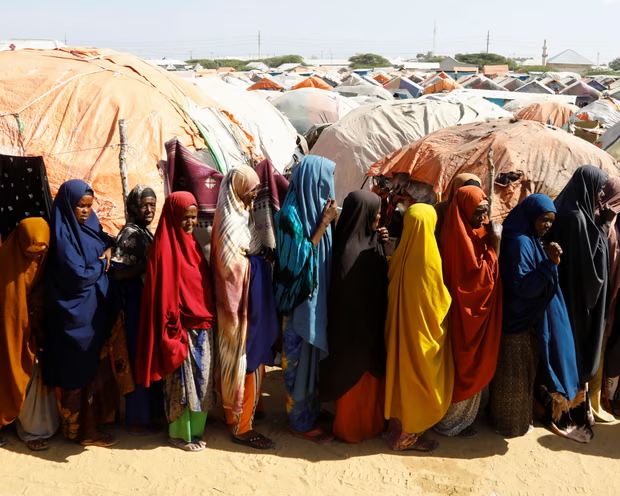
In the dead of night, in early July, 46-year-old Maryan Abdikadir Geedi decided to flee her small shop in the Somali town of Moqokori. The sound of gunfire had grown nearer, and whispers that al-Shabaab fighters were closing in filled the streets. Geedi had seen power shift many times since her marriage in 2013, but this time, she sensed the danger was different. “Just like how the rain comes and goes, so does control over Moqokori,” she said. “But this time it was different.”
Since February, the al-Qaeda-linked militant group al-Shabaab has reclaimed vast stretches of central and southern Somalia, erasing hard-won gains made by government forces and local militias with U.S. and Turkish air support. In July, the group’s fighters advanced to within 40 kilometers of Mogadishu, the capital, prompting fears of an assault on the city. For Geedi and her husband, along with their nine children, there was no choice but to escape.
They walked for hours through dust and darkness, heading toward the town of Buloburde, nearly 90 kilometers away. “The fear was immense,” Geedi recalled. “When the fear got too much to bear, I decided to leave.” Her story is one among thousands of families displaced as al-Shabaab pushes deeper into Somali territory, reversing years of counteroffensive progress.
In recent weeks, the frontlines have solidified, but government troops remain under pressure. Despite new construction projects and relative calm in Mogadishu, few believe the government’s position is secure. Somalia’s security forces have been weakened by low morale, corruption, and dependence on foreign troops, while the militants have grown stronger and more coordinated.
The United States has increased airstrikes against al-Shabaab targets, yet Washington has shown no intention of redeploying the hundreds of special forces withdrawn during Donald Trump’s first term. Instead, the fight on the ground has fallen largely to regional partners such as Turkey, the United Arab Emirates, and Uganda, along with Egypt, which recently committed a fresh contingent of troops.
“The reality is that Somalia’s survival depends on foreign support,” said Samira Gaid, a regional security analyst at the Mogadishu-based Balqiis thinktank. “We’ve reached a strategic stalemate. Al-Shabaab doesn’t need to take Mogadishu to win. They control most rural areas and many smaller towns, and the government can only hold its position because of external troops.”
That fragile balance has taken a heavy toll on soldiers and civilians alike. A 42-year-old veteran of the Somali National Army, now stationed in Beledweyne, listed more than a dozen towns he had fought to defend Beera Yabaal, Aboorey, Yasooman, Adan Yabaal, only to watch them fall again to the militants. “I’ve lost 20 friends and have been wounded twice,” he said. “We fight, and they return. They believe heaven awaits them if they die. Our soldiers just want to get paid and go home.”
His frustration reflects a wider crisis of confidence within Somalia’s security ranks. Analysts say morale has plummeted as the government struggles to pay salaries, provide equipment, or coordinate with allied militias. The collapse of local governance in many districts has allowed al-Shabaab to reimpose its own system of taxation, justice, and social control.
Observers point to the fragmented political landscape as a key factor behind the militant resurgence. “The government is deeply divided, and coordination between federal and regional authorities is weak,” said Ahmed Soliman, a Horn of Africa expert at Chatham House in London. “This lack of unity makes it difficult to sustain counterterrorism operations. Al-Shabaab is exploiting that fragmentation very effectively.”
Funding uncertainties are also threatening international support. The African Union force in Somalia, which costs around $160 million a year, faces a looming financial shortfall. Without it, experts warn, the government’s already precarious military position could quickly unravel.
Three weeks after Moqokori fell, al-Shabaab captured Maxaas, a key town that connects several northern routes. The seizure sent panic through nearby communities. “With each day that passed, more people started leaving,” said 37-year-old Nimo Abdi Barre, who fled with her husband and six children. “Homes had been abandoned, stores and markets left empty. The whole town felt haunted.”
Her family endured a grueling journey to Beledweyne, the capital of Hirshabelle province. “My children were vomiting and screaming,” she recalled. “We feared roadside bombs and landmines. My faith in God is what got me through.” Like thousands of others, Nimo has found temporary refuge in Beledweyne, but she feels trapped. “Nothing is worse than feeling like a refugee on your own soil,” she said.
Despite temporary stabilization of the frontlines, al-Shabaab’s resurgence underscores the fragility of Somalia’s political and military structure. President Hassan Sheikh Mohamud, who declared “total war” on the militants after taking office in 2022, faces growing criticism for failing to deliver on his promises. The government’s authority, limited even in urban areas, is being eroded village by village.
The humanitarian toll continues to rise as displacement spreads across central and southern Somalia. Aid agencies warn that shortages of food, water, and shelter could worsen if fighting resumes near Mogadishu. For many families, returning home is no longer an option.
In Beledweyne, Nimo looks toward the horizon where her old town once stood. “I want to return home,” she said softly. “But only time will tell if I ever get the chance.”