


French Prime Minister Sébastien Lecornu Resigns After Just 26 Days, Deepening France’s Political Crisis
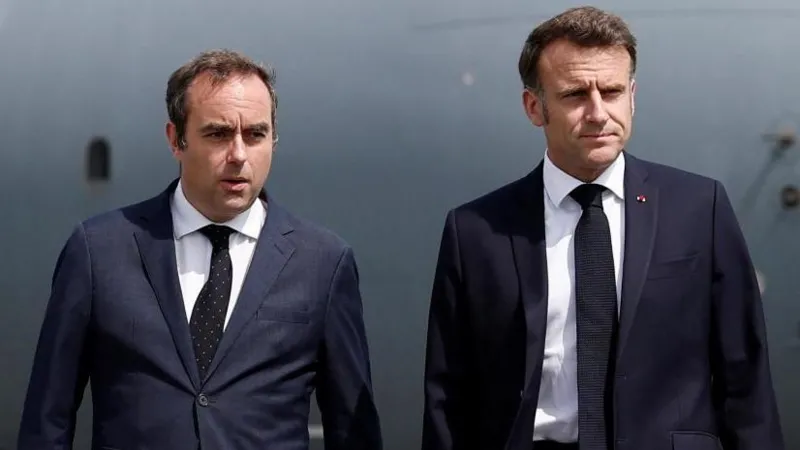
France has been thrown back into political turmoil after Prime Minister Sébastien Lecornu announced his resignation less than a month after taking office, citing a lack of cooperation among political parties and the failure to build consensus in an increasingly fragmented parliament.
Lecornu’s decision, announced on Monday morning, came less than a day after his cabinet was unveiled. The 37-year-old former armed forces minister met with President Emmanuel Macron at the Élysée Palace for nearly an hour before submitting his resignation. Shortly after the meeting, the presidency confirmed that Macron had accepted his departure.
“The conditions were not fulfilled for me to carry on as prime minister,” Lecornu told reporters outside Hôtel de Matignon, his official residence. He expressed frustration at the “partisan appetites” of France’s political factions, accusing them of putting personal and party ambitions above the country’s stability.
“I was ready for compromise, but all parties wanted the other side to adopt their programmes in full,” Lecornu said. “We could make this work if only we showed humility and put egos aside.”
Lecornu’s resignation marks yet another chapter in France’s deepening political instability. He was the country’s fifth prime minister in under two years, taking over from François Bayrou, whose government collapsed in September after parliament rejected his austerity budget.
Lecornu’s appointment last month was seen by many as a last-ditch attempt by President Macron to stabilise his administration after months of gridlock. However, opposition parties quickly turned against him. His cabinet, largely a continuation of Bayrou’s, faced immediate criticism for lacking fresh faces and failing to reflect the balance of power in the hung parliament.
By the time Lecornu presented his government to the National Assembly, the atmosphere was already charged with hostility. Lawmakers across the political spectrum from the far-right National Rally to the far-left France Unbowed had vowed to vote down his programme. The opposition accused Macron of clinging to power and ignoring the message sent by voters in last year’s snap elections.
Marine Le Pen, leader of the National Rally, reacted swiftly to the resignation. “The only wise thing to do now is to hold elections,” she said. “French people are fed up. Macron has put the country in an extremely difficult position. The joke’s gone on long enough.”
Calls for early elections grew louder throughout the day, with several opposition leaders insisting that the only way out of the crisis was to return to the polls. The president, however, has maintained that he will not resign before his term ends in 2027.
The roots of the political crisis trace back to July 2024, when snap parliamentary elections failed to produce a clear majority. The divided National Assembly has since paralyzed Macron’s reform agenda, with frequent clashes over spending cuts, pension reforms, and tax policies.
Bayrou’s fall in September was triggered by a rejected austerity budget that sought to slash €44 billion from public spending. France’s budget deficit reached 5.8 percent of GDP last year, while public debt ballooned to 114 percent, the third highest in the eurozone after Greece and Italy. Economists warn that without fiscal reform, France could face a downgrade from credit agencies and mounting pressure from Brussels.
Lecornu, a close Macron ally since the president’s first term, had hoped to bridge the widening gap between the centrist government and its opponents. His resignation, however, has reinforced fears that the current political system is becoming ungovernable.
As news of Lecornu’s departure broke, financial markets reacted sharply. Shares on the Paris exchange fell in early trading, with investor confidence shaken by uncertainty over who might succeed him. The euro also weakened slightly against the dollar amid growing concerns over France’s fiscal direction.
Political analysts described Lecornu’s resignation as both predictable and alarming. “The situation was untenable from the start,” said political commentator Jean-Michel Aphatie. “No one in the current parliament has the numbers or goodwill to govern. We are heading toward either another election or a prolonged paralysis.”
For now, President Macron faces one of the most daunting challenges of his presidency. With France struggling under high debt, sluggish growth, and social discontent, the resignation of yet another prime minister underscores the fragility of his leadership.
As Lecornu left Hôtel de Matignon for the last time, he offered a parting remark to reporters: “It wouldn’t take much for this country to work again. What it needs is goodwill.” But in today’s France, goodwill seems in very short supply.