


Gen Z Protests Shake Madagascar as Youth Demand President’s Resignation
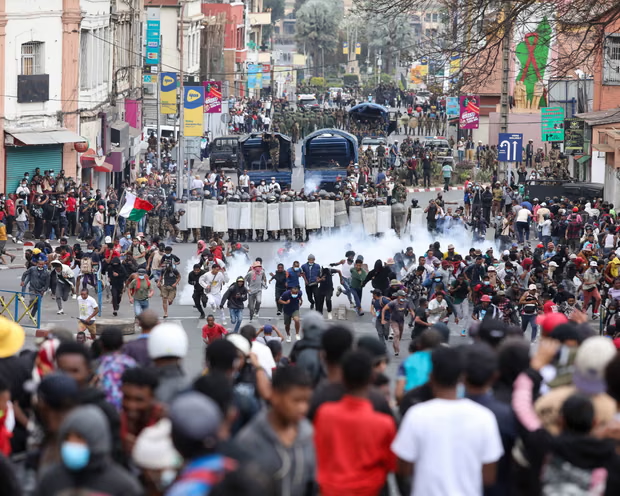
The streets of Madagascar’s capital, Antananarivo, remain tense as a youth-led movement continues to press for the resignation of President Andry Rajoelina. Despite the president’s announcement of dissolving his government on Monday, protesters dismissed the move as inadequate and vowed to escalate their campaign until a full political overhaul is achieved.
At least 22 people have been killed and more than 100 injured since the unrest began on September 25, according to the United Nations. The demonstrations erupted after local councillors were arrested for protesting against water and electricity shortages. What began as localized frustration has since developed into a national wave of anger, led primarily by young people who identify themselves as Gen Z Madagascar.
Madagascar, an Indian Ocean island nation of 32 million people, is one of the poorest countries in the world, with the World Bank estimating the average annual income last year at just $545. Corruption and inequality remain endemic, with Transparency International ranking the country 140th out of 180 nations in its 2024 Corruption Perceptions Index. Against this backdrop, the protesters say they are fighting not just for immediate relief but for a radical shift in the nation’s politics.
Activists have called for sweeping reforms, including the resignation of the president, the dissolution of parliament, the replacement of constitutional court judges and electoral commission officials, and the eradication of corruption that they claim originates from the president and his close business allies. They argue that only structural reform can guarantee a more just and accountable system.
“When he decided to dissolve the government, we saw it as a small victory, but it is not enough,” said a 26-year-old protester who spoke under the condition of anonymity due to fear of arrest. “We want a complete change of the system because it is the system that allows corruption to thrive and forces the poor into deeper suffering.”
For many of the young demonstrators, inspiration has come from youth-led protest movements abroad. The group cites recent uprisings in Nepal and Indonesia where young people mobilized online and in the streets to topple governments. Their tactics in Madagascar include using social media platforms for coordination and adopting protest symbols such as a reimagined skull-and-crossbones flag taken from the Japanese anime series One Piece. In this adapted version, the skull wears a satroka, a traditional Betsileo hat, symbolizing Malagasy identity.
President Rajoelina, who first came to power in 2009 through a coup following street protests against his predecessor, acknowledged the hardships faced by citizens in a televised address. “I understand the anger, the sadness, and the difficulties caused by power cuts and water supply problems,” he said. “I heard the call, I felt the suffering, I understood the impact on daily life.” While he expressed a desire for dialogue with young people, many activists say they have no faith in his sincerity.
Some protesters insist they will only participate in talks if they are public and fully transparent, while others reject any form of dialogue, believing the president’s overtures are a tactic to divide and weaken their movement. “It is literally a mafia,” said an 18-year-old who helps manage the group’s online presence. “They are going to try to speak to us, but it will never be in our interest.”
The protests have spread beyond Antananarivo, reaching other towns and cities where frustration with unemployment, corruption, and poor infrastructure is deeply felt. Reports of looting have surfaced, but the activists deny responsibility, saying they have organized cleanup campaigns to demonstrate their commitment to peaceful and constitutional protest.
Regional echoes of unrest are being felt as well. Similar Gen Z protests in Morocco this week led to deadly clashes with security forces near Agadir, raising fears that youth-driven movements could become a broader trend across Africa. In Madagascar, activists have openly stated that they are drawing lessons from their peers in Asia and North Africa, adapting strategies and sharing symbols across borders.
Officials loyal to the president accuse the protesters of seeking to destabilize the country and warn against a repeat of the 2009 coup that first brought Rajoelina to power. The president’s spokesperson, Lova Hasinirina Ranoromaro, wrote in a Facebook post that government supporters had lost jobs and property in the chaos, accusing demonstrators of destruction. The government has made no official comment on accusations of heavy-handed security tactics.
The young protesters say they are aware of the dangers they face. Many have gone into hiding while others continue to mobilize publicly, despite fears of arrest or violent retaliation. For them, the stakes are too high to back down.
“I know the risks but I also know this may be our only chance to secure a better future,” said a 25-year-old activist. “If I stop now, who will stand up again? We have been brought to our knees for 15 years. Now we are standing up, and we are the last hope of this generation.”
The death toll and the determination of the protesters have drawn international attention, but there has been little external pressure on Rajoelina so far. Observers warn that the situation could spiral further if dialogue is not opened in good faith, and if security forces continue to respond with lethal force.
For now, Madagascar’s young protesters say they are unwilling to compromise on their demands. The dissolution of the government is seen as too little, too late. They want a wholesale transformation of the political system, and they believe that their generation is ready to see it through.
As tensions mount in Antananarivo and across the country, the struggle between a disillusioned generation and a president who has ruled for much of their lives appears set to define Madagascar’s immediate future. Whether the protests can achieve their ambitious goals or whether they will face another violent crackdown remains to be seen.