






Supreme Court Guts Voting Rights Act in Landmark Blow to Democracy as Midterm Election Maps Are Redrawn Across Southern States
Published: Tuesday, May 5, 2026 | Breaking News
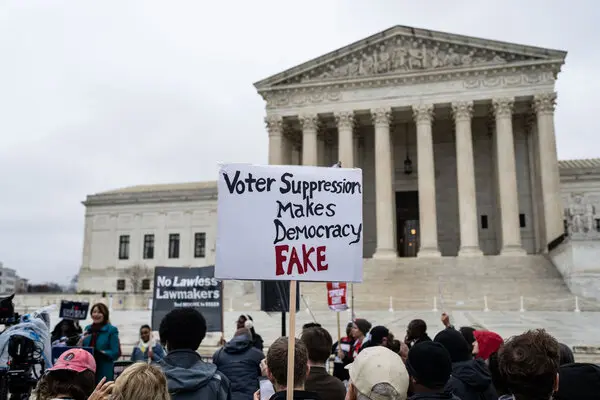
The United States Supreme Court has delivered what civil rights attorneys and constitutional law scholars are calling one of the most consequential rulings on American democracy in decades, gutting key provisions of the Voting Rights Act in a decision that immediately triggered a scramble across Southern states to redraw congressional maps in ways that could fundamentally reshape the balance of power in the House of Representatives heading into the 2026 midterm elections.
The ruling, which came down from the court’s conservative majority, removed critical preclearance and enforcement mechanisms that federal civil rights law had used for more than half a century to protect minority voting communities from discriminatory redistricting, voter suppression tactics, and other measures designed to dilute the electoral power of Black, Latino, and Indigenous voters. Civil rights organizations described the decision as a devastating blow to the democratic participation of communities that fought for these protections through decades of struggle and sacrifice.
Maya Wiley, a prominent civil rights attorney and legal commentator, called the ruling a systematic dismantling of the legal architecture that has protected minority voting rights since the 1960s. “This is not a marginal adjustment to existing law,” Wiley told reporters. “This is a green light for state legislatures that have wanted for years to draw maps that permanently disadvantage minority communities and cement one-party dominance by diluting the votes of people of color.”
Georgia, Alabama, Mississippi, and South Carolina moved with extraordinary speed in the hours following the ruling, with Republican-controlled state legislatures calling emergency sessions or activating pre-prepared redistricting plans that had been held in reserve pending the court’s decision. Legal challenges to the new maps are already being filed, but with the Supreme Court having narrowed the available legal tools for challenging discriminatory maps, the path to judicial relief for affected communities is now far more difficult.
The timing of the ruling, with the 2026 midterm elections now just months away, means that the new maps could determine which party controls the House of Representatives for the next two years. Analysts at multiple nonpartisan redistricting research organizations projected that the maps being drawn in Georgia and Alabama alone could shift between three and seven House seats from competitive or minority-represented districts to safe Republican seats, a swing large enough to change the chamber’s majority if current margins hold.
Congressional Progressive Caucus chair Pramila Jayapal unveiled what she called an “Affordability Agenda” in the days following the ruling, framing the economic and political stakes together for Democratic voters ahead of the midterms. The agenda includes proposals on housing costs, healthcare access, energy prices, and worker rights, but its political effectiveness will depend entirely on whether Democratic organizing can overcome the structural disadvantages that the redrawn maps are designed to create.
Read More: Microsoft Offers Historic Buyouts to 7% of US Workforce as AI Automation Triggers Deepest Big Tech Restructuring in Company History
Former Attorney General Eric Holder, who led the Obama administration’s voter protection efforts, called the ruling a betrayal of American founding principles and announced that the National Democratic Redistricting Committee would file legal challenges in every state where maps are redrawn in ways that violate remaining constitutional protections. “The courts have narrowed the tools, but they have not eliminated them,” Holder said. “We will fight every discriminatory map in every state, and we will take this fight to the voters who understand what is at stake.”
Maine’s Governor dropped her US Senate bid on the same day as the ruling, citing the changed political landscape, paving the way for Graham Platner to secure the Democratic nomination. The Democratic Party’s path to retaining or expanding its Senate presence runs through a handful of competitive states where voter enthusiasm and turnout operations will determine outcomes that no court ruling can fully predetermine. The battle for American democracy’s ground rules is now being fought simultaneously in federal courtrooms, state legislatures, and precincts across the country.